
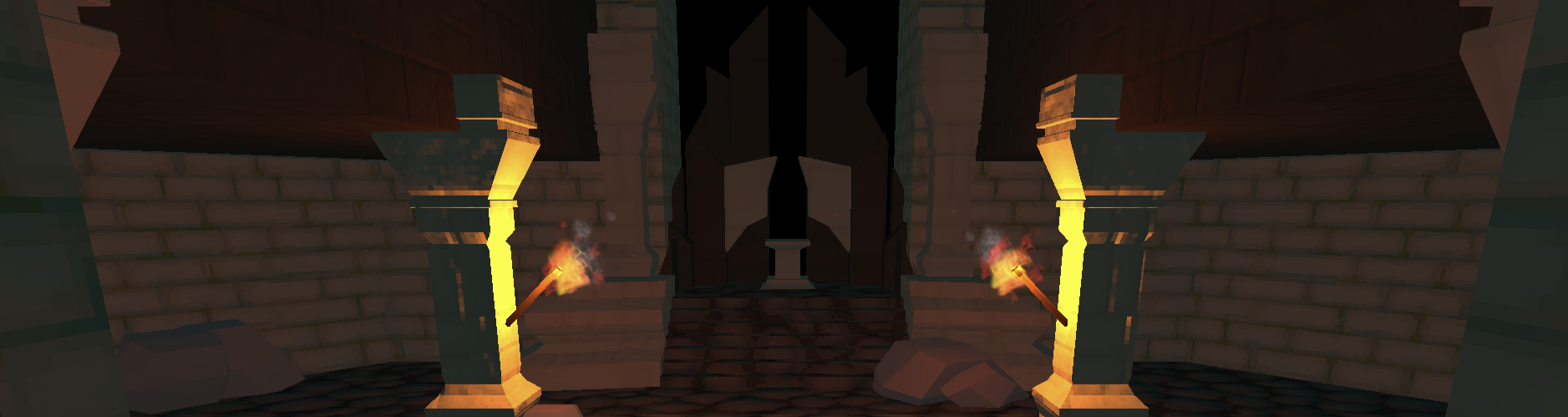
aTTRITION
Role: Level Designer | Project Type: Personal Team | Duration: 3 Weeks | Tools: Unity 6 | Created: Winter Break 2024
Overview
Project Introduction
Attrition is a collaborative passion project developed over Winter Break alongside a team of 8 other Game Designers. Our goal was to prototype an Isometric Dungeon-Crawler, where the environment changed depending on the player’s actions in a previous life. I worked as a level designer on this project, helping shape the rooms' design for the game.
My Contributions
Built 4 dungeon rooms using Unity’s Probuider tool.
Collaborated with the other level designer to determine the aesthetic of each room & how they would connect.
Used consistent metrics to match art assets & implemented finished art into each room I authored.
Built a gym level, determining the spatial arrangement & metrics of future levels.
Worked alongside other game designers to create consistent camera rules for combat & exploration.
Created the gym level within the first few days of the project, for use by the AI designer to create & test enemies in.
Used this level to give the rest of the team an overall idea of how the dungeons would look.
Sprint 1: Planning
Determining Camera Rules
The other level designer and I collaborated to establish a set of rules for camera positioning in the level. The goal was to ensure readability and consistency, so the player doesn’t have to think about the camera; it just feels natural.
In Exploration & Narrative Spaces
The camera is freeform; we can adjust the camera’s position and rotation as seen fit for any cinematic shots, or areas of narrative importance we want the player to focus on
However, this needs to be continually playtested to ensure the camera changes aren’t jarring
In Combat Spaces
The camera’s X rotation should always be 45 degrees, but the Y rotation can be adjusted.
Camera height should be consistent across all rooms at 10 Unity units high.
Creating the Gym Level
Inspiration & Aesthetic
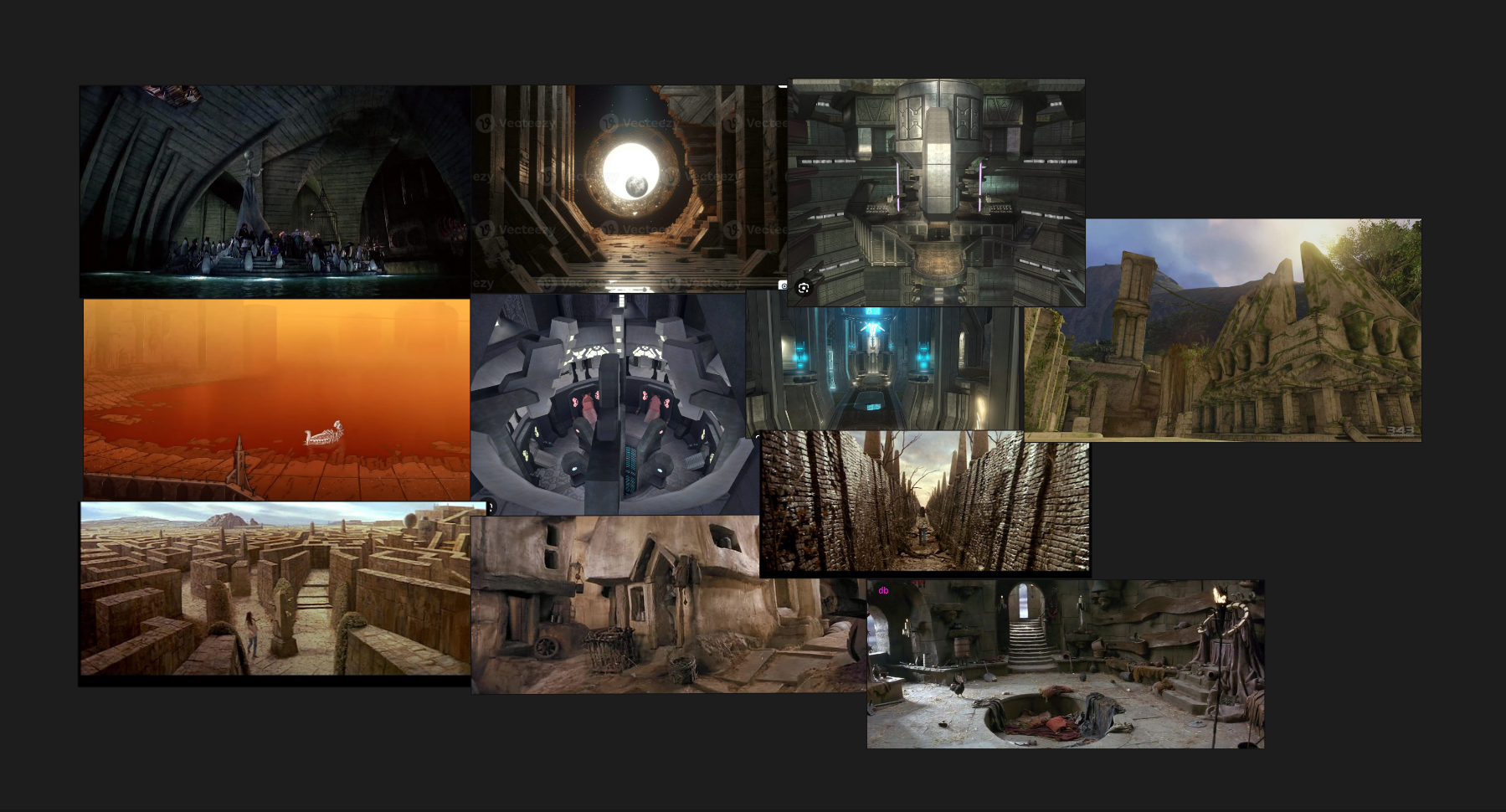
A motto we had for the dungeons was “Big indoor, vast spaces”. We wanted the player to feel small, to reiterate that feeling of despair.
When figuring out what the dungeons would look like, we drew inspiration from the Forerunner architecture from Halo.
We wanted to create an ancient yet futuristic look by integrating sharp and angular geometry. We wanted this place to feel “otherworldly”
Another rule we gave ourselves for the architecture was to create contrasting shapes within the environment, ie. Circles vs. Edges.
Our aim was to create clarity in the environment while reinforcing that otherworldly theme.
Sprints 2-3: Development
Building Rooms for Modularity
Team Process
Retrospective
What Went Well
What Needs Improvement
What I’ve Learned